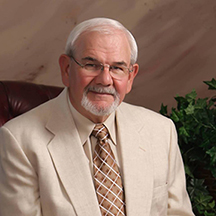
Rev. Don Campbell
Deuteronomy 11-13
THOUGHT FOR TODAY, March 15, 2019
“NOT BY WORKS OF RIGHTEOUSNESS”
Moses calls for the total commitment of Israel to the God of Abraham: “And if you will indeed obey my commandments that I command you today, to love the Lord your God, and to serve him with all your heart and with all your soul, he will give the rain for your land in its season, the early rain and the later rain, that you may gather in your grain and your wine and your oil. And he will give grass in your fields for your livestock, and you shall eat and be full” (Deuteronomy 11:13-15). Loving God with all our heart and all our soul means to love him from center to circumference—the most hidden thought of the heart to the most apparent acts of obedience.
Let’s be a little more specific. Loving God with all one’s heart and soul means at least three things:
First, love is without calculation. When the rich, young ruler walked away from Jesus, unwilling to sell all and follow, Peter said, “We have left everything to follow you! What then will there be for us?” (Matthew 19:27). Jesus assured them that they would be rewarded, even sitting on 12 thrones, judging the 12 tribes, but let’s hear the rest of the story, as recorded by John: “When they had finished eating, Jesus said to Simon Peter, “Simon son of John, do you truly love me more than these?” “Yes, Lord,” he said, “you know that I love you.” Jesus said, “Feed my lambs.” Again Jesus said, ‘Simon son of John, do you truly love me?’ He answered, ‘Yes, Lord, you know that I love you.’ Jesus said, ‘Take care of my sheep.’ The third time he said to him, ‘Simon son of John, do you love me?’ Peter was hurt because Jesus asked him the third time, ‘Do you love me?’ He said, ‘Lord, you know all things; you know that I love you.’ Jesus said, ‘Feed my sheep. I tell you the truth, when you were younger you dressed yourself and went where you wanted; but when you are old you will stretch out your hands, and someone else will dress you and lead you where you do not want to go.’ Jesus said this to indicate the kind of death by which Peter would glorify God. Then he said to him, ‘Follow me!’” (John 21:15-19).
Second, loving God with all our heart and soul means we love without qualification: “For I fully expect and hope that I will never be ashamed, but that I will continue to be bold for Christ, as I have been in the past. And I trust that my life will bring honor to Christ, whether I live or die. For to me, living means living for Christ, and dying is even better (Philippians 1:20-21). Shortly after its founding, the American Baptist Foreign Missions Society adopted a seal which shows an ox standing before a plow and an altar in the background. Above is a banner which says, “Ready for Either.” That is what it means to love without qualification.
Third, love is without equivocation. Centuries after Moses wrote, Elijah challenged the descendants of those whom Moses called a stubborn and rebellious people: “And Elijah came near to all the people and said, ‘How long will you go limping between two different opinions? If the Lord is God, follow him; but if Baal, then follow him.’ And the people did not answer him a word” (1 Kings 18:21).
Instead of a total commitment to the Lord, we have religion, of which C. S. Lewis wrote: “It carries the suggestion that this is one more department of life, an extra department added to the economic, the social, the intellectual, the recreational, and all the rest. But that whose claims are infinite can have no standing as a department. Either it is an illusion or else our whole life falls under it. We have no non-religious activities; only religious and irreligious (as quoted in Reflections, C.S. Lewis Institute, August 2014).
When religion is substituted for a loving relationship with God, we cease being on fire or zealous and become an emetic to the Lord—that’s Greek for “makes you want to punk.” I know your deeds, that you are neither cold nor hot. I wish you were either one or the other! So, because you are lukewarm—neither hot nor cold—I am about to spit you out of my mouth (Revelations 3:16). [The word translated “spit” is the Greek word “emeo,” from which we get the word “emetic,” or something that causes vomiting]
CONNECTIONS – Colossians 2:23
1. The story is told of a village in Africa that wanted to spread the gospel to neighboring villages. They drew a circle, and everyone was to bring whatever they wished to contribute to the mission and place it in the circle. One poor brother was dejected because he had nothing he could place in the circle. Then he stepped forward with great deliberation and placed himself in the circle. He would go. When it is easy to give money, do we sometimes forget to give ourselves?
2. The word “religion” or “religious” is not found in the O. T. in any of the standard translation and only five times (depending on the version) in the N. T. The King James translators tell us that some were guilty of will-worship (Colossians 2:23). Other translations have “self-made religion,” and Phillips has “self-inspired.” Does this suggest that our neat divisions of “religious” and “secular” miss the mark?
