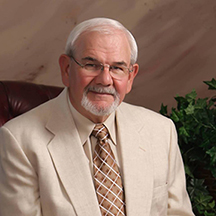
Rev. Don Campbell
1 Chronicles 7-10
THOUGHT FOR TODAY, April 29, 2019
“A TOMBSTONE EPITAPH”
Our story is not about the newspaper named the Tombstone Epitaph, made famous by the gunfight at the Ok Corral. It is about what could have been the epitaph on the headstone of Saul had he had one: SAUL – FIRST KING OF ISRAEL – HE DIED FOR HIS BREACH OF FAITH. The text says, “So Saul died for his breach of faith. He broke faith with the Lord in that he did not keep the command of the Lord, and also consulted a medium, seeking guidance. He did not seek guidance from the Lord. Therefore the Lord put him to death and turned the kingdom over to David the son of Jesse” (10:13-14).
The text says that the Lord put him to death. Had the Word of God not stated this, we would be inclined to see him simply as one who fell on his own sword rather than be captured by the enemy. Saul was further disgraced in that following his suicide, the Philistines beheaded him and put his head in the temple of their gods. The valiant men of Jabesh-gilead recovered the body and gave it a proper burial (10:8-12).
One of the three fettered travelers in Bunyan’s Pilgrim’s Progress was “Presumption.” When “Christian” attempted to arouse him and his two companions “Simple” and “Sloth,” he replied with a pseudo-wise proverb: “Every vat must stand on its own bottom.” If he had meant that each of us must someday stand before the judgment bar of Christ, he would have been speaking the truth. Clearly, that is not what he meant, for he went back to sleep still shackled. The idiom is defined today as meaning: “that every person or entity in a group should be self-sufficient. This idiom, often abbreviated to ETOB, is common in academic speech to mean that each department or school should be responsible for raising its own funds” (A Way With Words, radio program).
Paul teaches us that we must be God-sufficient, not self-sufficient: “We are confident of all this because of our great trust in God through Christ. It is not that we think we are qualified to do anything on our own. Our qualification comes from God. He has enabled us to be ministers of his new covenant. This is a covenant not of written laws, but of the Spirit. The old written covenant ends in death; but under the new covenant, the Spirit gives life” (2 Corinthians 3:4-6, NLT).
The great sin of declared atheists is presumption—believing that they are sufficient in all things. The greater danger for us is not presumptuous atheism but presumptuous legalism in which we take a stand on our goodness rather than God’s grace (Romans 5:1-2). We may embrace the death of Christ as the means of our salvation from the state of sin (Romans 6:1-4), but presumptuously believe that the Christian walk is a matter of our independently putting one foot in front of the other. We attempt to live without the Spirit, becoming waterless clouds, fruitless trees, and wandering stars, devoid of the Spirit (Jude 12-13, 19).
Paul wrote, “If the Spirit of him who raised Jesus from the dead dwells in you, he who raised Christ Jesus from the dead will also give life to your mortal bodies through his Spirit who dwells in you” (Romans 8:11). He was not speaking of the resurrection of the body on the last day, but of the newness of life which he introduced in Romans chapter six. This is clear from the context: “For the law of the Spirit of life has set you free in Christ Jesus from the law of sin and death. For God has done what the law, weakened by the flesh, could not do. By sending his own Son in the likeness of sinful flesh and for sin, he condemned sin in the flesh, in order that the righteous requirement of the law might be fulfilled in us, who walk not according to the flesh but according to the Spirit. For those who live according to the flesh set their minds on the things of the flesh, but those who live according to the Spirit set their minds on the things of the Spirit. For to set the mind on the flesh is death, but to set the mind on the Spirit is life and peace. For the mind that is set on the flesh is hostile to God, for it does not submit to God’s law; indeed, it cannot. Those who are in the flesh cannot please God. You, however, are not in the flesh but in the Spirit, IF IN FACT THE SPIRIT OF GOD DWELLS IN YOU. ANYONE WHO DOES NOT HAVE THE SPIRIT OF CHRIST DOES NOT BELONG TO HIM. (Romans 8:2-9).
Most of us need not worry that our tombstone may read PRESUMPTUOUS because we are atheists, but because we have broken faith with God, believing that we are saved by grace through faith from our dead state (Ephesians 2:1-7), but that we will reach the goal through our own goodness.
CONNECTIONS
1. Reputation is one thing; character is another. The church at Sardis had a reputation (“name,” KJV) that they were alive, but they were dead (Revelations 3:1). Their reputation did not match their character. Does what men think about us (reputation) match our character (what God knows about us)?
2. What one word describes your reputation?
