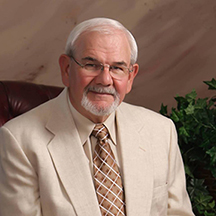
Rev. Don Campbell
Leviticus 8-10
THOUGHT FOR TODAY, FEBRUARY 15, 2019
GOD SAYS WHAT HE MEANS AND MEANS WHAT HE SAYS
That God says what he means and means what he says is demonstrated in Leviticus 10:1-3: “Now Nadab and Abihu, the sons of Aaron, each took his censer and put fire in it and laid incense on it and offered unauthorized fire before the Lord, which he had not commanded them. And fire came out from before the Lord and consumed them, and they died before the Lord. Then Moses said to Aaron, ‘This is what the Lord has said: “Among those who are near me I will be sanctified, and before all the people I will be glorified.”’ And Aaron held his peace.”
There are several marks of presumption in their sin: The offering of incense was to be by the high priest. It was to be offered at prescribed times. Fire from the altar was to be used. There may have been other things wrong with what they did, but the inspired text addresses only one, the strange or unauthorized fire. The sin of King Saul in offering sacrifices is much like the sin of Nadab and Abihu. God, speaking through Samuel, had instructed Saul to totally destroy the Amalekites, but the kept Agag the king alive, along with the best of the spoil. When Samuel confronted Saul, he—like many so-called leaders—would not accept responsibility for his actions, but passed the buck, “But the people took of the spoil, sheep and oxen, to sacrifice to the Lord your God in Gilgal.” Samuel’s words were not only a rebuke of Saul but of all who would act presumptuously when worshiping God:
“Has the Lord as great delight in burnt offerings and sacrifices,
as in obeying the voice of the Lord?
Behold, to obey is better than sacrifice,
and to listen than the fat of rams.
For rebellion is as the sin of divination,
and presumption is as iniquity and idolatry.
Because you have rejected the word of the Lord,
he has also rejected you from being king.” (1 Sam 15:22-24).
When discussing acceptable and unacceptable worship in the Christian age, some say, “It doesn’t really matter how we worship, so long as we are sincere.” When Jesus said that those who worship God must worship in spirit and truth (John 4:24), he was speaking to a Samaritan woman who had brought up a centuries-old debate about whether Mt. Gerizim or Jerusalem was the proper place to offer sacrifices. He could have simply said, “Jerusalem,’ but the time was quickly coming when worship would not be place-center, but heart-centered. In my book Worshiping God in Spirit and Truth, I wrote: “Unlike that on Mars Hill, which is also called the Areopagus (Acts 17:19), the worship on Mount Gerizim was a mongrelized worship offered by a mongrelized people, resulting from Jews inter-marrying with Assyrians. They recognized Jacob as their father and accepted—at least in theory—the first five books of the Bible, had their own temple and priesthood and they looked for the Messiah. To this day, when New Testament worship is mixed with Old Testament ritual, doctrines of men, and the desires of the worshipers, the result is a mongrelized people and a mongrelized religion” (p.23).
To worship God in truth is to worship God according to the teachings “delivered,” not by this synod or that synod, this man or that man, but by the Holy Spirit: “Therefore we must pay much closer attention to what we have heard, lest we drift away from it. For since the message declared by angels proved to be reliable, and every transgression or disobedience received a just retribution, how shall we escape if we neglect such a great salvation? It was declared at first by the Lord, and it was attested to us by those who heard, while God also bore witness by signs and wonders and various miracles and by gifts of the Holy Spirit distributed according to his will” (Heb 2:1-4).
Nadab and Abihu, king Saul, Ananias and Sapphira (Acts 5:1-11), and Herod (Acts 12:20-23) all learned the hard way that God says what he means and means what he says. Someone has said, “Smart people learn from their own mistakes. Wise people learn from the mistakes of others.” Be wise, not sorry.
CONNECTIONS
1. A wise man said: “God calls us to worship and I find this missing in the Church of the Lord Jesus Christ in this day. Instead of worship, we are now second in entertainment to the theaters. I want to tell you something. If I want to see a show I know where I can see a good one put on by top flight geniuses who know what they are doing. If I want a show I’ll duck out and go down to a theater and see a show hot out of Hollywood or London by men and women who are artists in their field. I will not go to a church and see a lot of ham actors putting on a home talent show. And yet, that’s where we are in evangelical circles. We’ve got more show in evangelical circles than anywhere else. (A. W. Tozer (1893-1963).”The Chief End of Man,” Sermon #4, Toronto, 1962). From whence comes the desire for entertainment?
2. Will those who hunger and thirst after righteousness, but are feed jokes, cute little stories, and so forth be filled?
