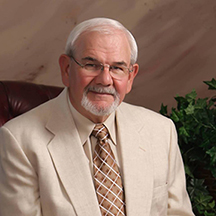
Rev. Don Campbell
Psalms 102-104
THOUGHT FOR TODAY, April 30, 2019
“FIVE REASONS TO BLESS THE LORD”
The three psalms in today’s reading tell of the frailty of humanity and the power and glory of God. They drip with suggestions of the Messiah and are quoted by New Testament writers. The author is not named for Psalm 102 and some commentators believe that the entire psalm is Messianic, with sufferings described in verse 1-12 being the words of Messiah himself. Whoever the speaker, out of despair shines an abiding faith in the greatness and goodness of God. Psalm 103 is ascribed to David who begins, “Bless the Lord, O my soul, and all that is within me, bless his holy name! Bless the Lord, O my soul, and forget not all his benefits (vv.1-2).
David then lists five benefits enjoyed by those who bless the Lord with all that is in them: One, he forgives all our iniquity. Two, he heals all our disease. Three, he redeems our lives from the pit. Four, he crowns us with steadfast love and mercy. Five, he satisfies us with good so that our youth is renewed like the eagle’s (vv.3-5).
As in all poetry, there are statements which if pressed to the extreme teach something the Holy Spirit did not intend for us to learn. If we take the healing of all diseases as meaning God has promised perfect health for those who bless him with all their hearts, we are confronted with Paul’s affliction, as well as the suffering of saints throughout the ages. If we assume that the diseases are those of the body, we might be wrong. Isaiah began his prophecy by diagnosing not the physical sicknesses of Israel, but the diseases of the soul:
Ah, sinful nation,
a people laden with iniquity,
offspring of evildoers,
children who deal corruptly!
They have forsaken the Lord,
they have despised the Holy One of Israel,
they are utterly estranged.
Why will you still be struck down?
Why will you continue to rebel?
The whole head is sick,
and the whole heart faint
From the sole of the foot even to the head,
there is no soundness in it,
but bruises and sores
and raw wounds;
they are not pressed out or bound up
or softened with oil (1:1-6).
When the Messiah stood before his hometown folk and quoted Isaiah, he was not promising that the good news to the poor was “Name you material blessing and claim it,” nor did it have anything to do with opening prison gates and setting prisoners free, nor did he seek to eradicate physical blindness. His words apply to the rescue those bound by the shackles of sin (John 8:33-38), blinded to sin and holiness (John 9:35-41), and who hunger and thirst after righteousness (John 6:25-40).
Let us never forget what God never fails to remember:
“As a father shows compassion to his children,
so the Lord shows compassion to those who fear him.
For he knows our frame;
he remembers that we are dust.
As for man, his days are like grass;
he flourishes like a flower of the field;
for the wind passes over it, and it is gone,
and its place knows it no more.
But the steadfast love of the Lord is from everlasting to everlasting on those who fear him,
and his righteousness to children’s children,
to those who keep his covenant
and remember to do his commandments (Psalms 103:13-18).
CONNECTIONS
1. The first stanza of Jennie Wilson’s 1904 hymn reminds us that our days are like grass and God’s love is from everlasting to everlasting: “Time is filled with swift transition—Naught of earth unmoved can stand—Build your hopes on things eternal, Hold to God’s unchanging hand.” Are fewer and fewer people clinging to God’s everlasting love?
2. We know that God is for us and Christ intercedes for us and no one, including Satan, can separate us from the love of God (Romans 8:31-35). Jude exhorts, “keep yourselves in the love of God” (v.21). He gives five participles that tell us how we keep ourselves in God’s love: building, praying, waiting, snatching, hating (vv.20-23). What are we to build? In what are we to pray? For what are we to wait? What are we to snatch? What are we to hate?
